
In all likelihood, you either have one of these soda fountain sets, have seen one, or own something that is a corollary of an A.H. Andrews invention. Speaking of the soda fountain set, they aren't rare, but they are relatively old. When I was looking for a quaint bistro set for our front porch, these sets were everywhere (Craigslist, Ebay, Etsy, and local antique shops) and in all prices & conditions.
 |
| Scene from my last post, Evolution of a Porch |
Our c.1889 Bistro/Soda/Ice Cream Parlor Set
 |
| Our 127-year-old A.H. Andrews "Confectioneries" Set |
a man and his company.

I love things that have a past -- things with a history; a story to tell.
Let's start at the beginning!
Setting the Historical Scene

The American Civil War (April 12, 1861 - May 9, 1865) had just ended. It was a time of reconstruction -- a time of boom in every conceivable sector -- agriculture, invention, industrial & factory, transportation, and rapid economic growth!
America was now in it's Gilded Age! (1870s - 1900)
It was a time of opportunity, and often those who were ambitious and worked hard, found prominence and sometimes great wealth.
Owner/Inventor & Great Success
 |
| A.H. Andrews The Hand-book of Chicago Biography 1893 |
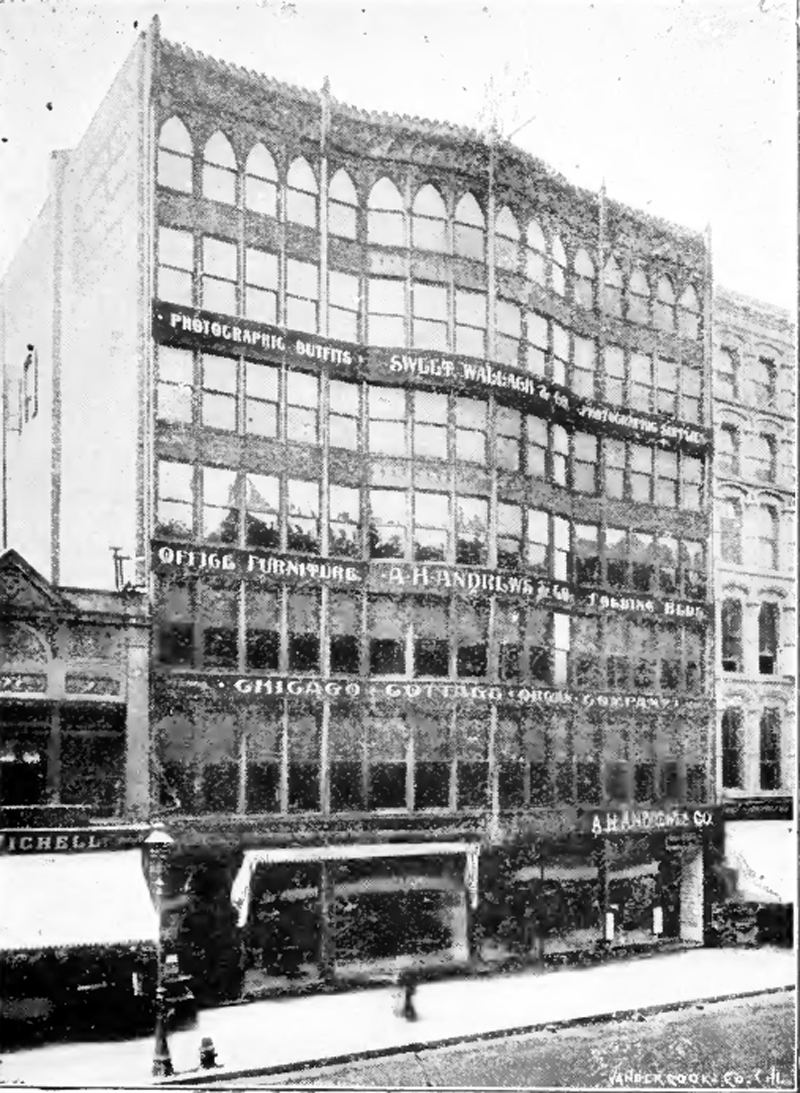
As a side note, the A.H. Andrews Building was one of the first businesses to be rebuilt (in 1872) following The Great Chicago Fire of Oct. 1871.
The A.H. Andrews Building 1872

By the beginning of the 1880s, A.H. Andrews & Co. had become the LARGEST manufacturer of commercial furniture; quite a feat in Chicago's robust furniture industry; employing about 500 people and manufacturing around $600,000/yr worth of school and office furniture.
 |
| A.H. Andrews Bldg. 1893 |
 |
| 1881 Catalog (190 pgs) You can read this catalog posted by the Library of Congress |
The July, 1904 banker's periodical, "Common-Sense", wrote a very nice 3-page biography on Mr. Andrews in which it stated, "the story of Mr. Andrews' career is an intensely interesting one. From first to last he had no help, no favors. It has been hard work, lots of it, and a steady, strong up-hill pull." If you asked Mr. Andrews to sum up his success in one term, it would be, "hard work".
A Pioneer Manufacturer of School Furniture & Supplies
 |
| The Andrews Triumph school desk & seat combined, which was known to every school child in America, was one of the first of Mr. Andrews' inventions in 1867. |
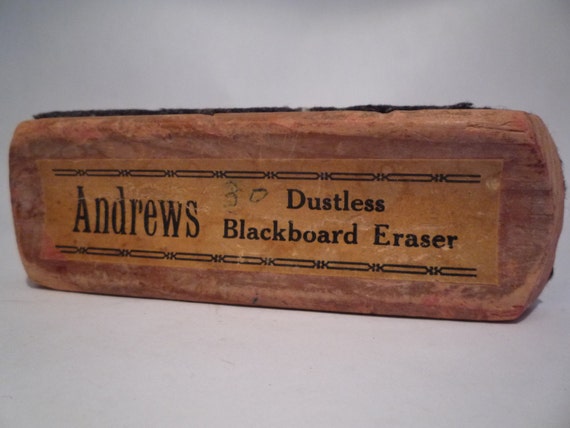 |
| Little eraser earns a fortune for it's inventors! |
Not Just School Supplies
Not only was A.H. Andrews & Co. BIG in all-things schoolish, they manufactured furniture for offices, banks, telephone operators, drug stores, confectioneries (my set), restaurants, clubs, billiard parlors, barber shops, shoe stores, medical ofs. & hospitals, reception rooms, churches, theaters, and lumberyards (take breath); did I miss anything? The A.H. Andrews Company became the largest manufacturer of school and bank furniture in the world!
 |
| A.H. Andrews ad from 1883 Chicago Elite Directory |
| Andrews' GEM Folding Bed came well before "the Murphy Bed". |
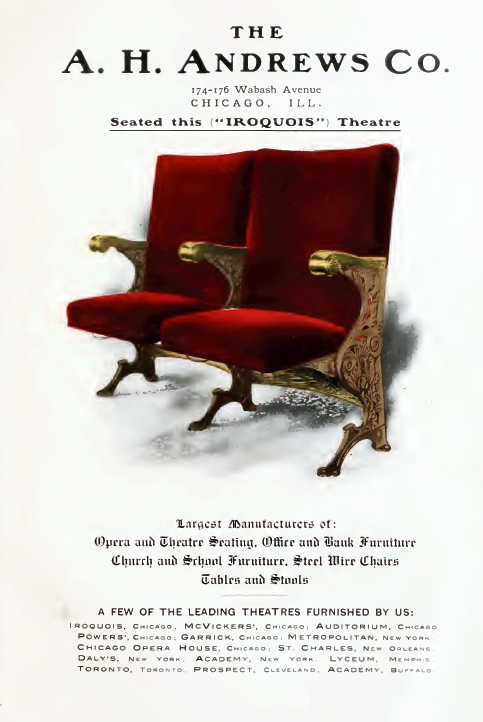
"First in the field, -- and still leading!"


of merry sunshine on every piece -- a suggestion
of cheerful brightness that is irresistible!"
(quote from Andrews M-16 catalog (& ads))
"It was our Mr. A. H. Andrews who first produced and marketed twisted steel wire furniture such as this catalog illustrates. Practically every new design and every important betterment of the older patterns has originated in our big factory, where advanced ideas are constantly being developed and tested out by the experimental department."
(quotes from the "Andrews Metal Furniture" catalog)
 |
| Andrews Ad c.1903-1905 (This is when the Andrews Company was at this address) |
A. H. Andrews & Co. enjoyed a leading status throughout the 1880s, peaking in 1885. It is said that the Company started making metal furniture in the early 1890s, although my table may slightly predate that as I will show you in a minute.
Ahh, Metal Furniture, Can We Talk About the Table & Chair Finally???
Ah Yes, so getting to my set... finally.
 |
| Here is my A.H. Andrews Set tucked in the corner of my front porch to protect it from the elements. The table and chair (left,corner) are definitely an Andrews, the chair on the right I bought a bit later and may be by another company that copied the Andrews chair with slight variations. |
 |
| Page 33 from The A.H. Andrews Co. Catalog M-16 "Concerning Chairs and Tables" The Page Reads in Part: ROUND WOOD TOP TABLES "Note that all our round wood tops, solid quartered oak or birch mahogany, in addition to being thoroughly seasoned, are made, always, with a reinforcing wood ring on the under side, and will not warp. It may be added that we have never put them out any other way. Note also that in ANDREWS' tables the legs are now seated in pressed steel—not cast iron —sockets, so that breakage at this point, in setting up tables, is practically impossible." They came in 18", 24", 30" 36" and 42" diameters (My table is 24" with "Japanese Copper"). |
 |
| As you can see, my table top is not in excellent shape, but it's an original; (everything is original on it) and it's still smooth. I may try to clean it up later, but I just have a plastic tablecloth on it for now. I don't think I will be painting it as that takes away from the value. I specifically wanted the 24" top as my porch is narrow plus 24 inches seems to be the standard diameter of bistro tables. The real gem of the table is on the flip side... |
 |
| It is common to see these tables & chairs around, but it's a bit more rare to find one with it's original wood and stamp on the bottom side. Mine is even more rare as it has it's PRE-PATENTED stamp. It reads: "From A.H. Andrews Co. Manufacturers Chicago Patent Applied For G.O." (I don't know what the "G.O." stands for, if anyone can enlighten me on that, I'd appreciate it.) |
 |
Page 12 from The A.H. Andrews Co. Catalog M-16
I have two "Japanese Copper" chairs
The Page Reads as Follows: "A standard chair for all purposes. Heavy 3-ply veneer seat (either quartered oak or birch mahogany) 14½ inches in diameter. Frame of a special grade of Bessemer steel, regularly finished in durable Japanese copper, but can be had if desired in nickel plate or in white enamel. Weight 12½ pounds. Japanese copper finish $2.00 Nickel plated finish $3.00 White enamel finish $3.20 Specify whether oak or birch mahogany veneers are wanted, and also indicate the finish desired on the metal parts (chairs finished in white enamel will have seats enameled also). In an ANDREWS chair, you have a springy, cushion-like support for your back—a support that yields slightly with each movement of one's body, but comes back to place instantly when the pressure is removed. No wooden chair can compare with an ANDREWS in respect to durability and sanitary cleanliness." |
 |
| Andrews "Sweetheart" chairs |
Being Real: The A.H. Andrews Co. prided themselves on a quality product, or at least that was their sales spiel, perhaps some things were of higher quality than others... for example, the "Japanese Copper" finish of the metal furniture was nothing more than a sprayed-on copper rust inhibitor, but it does give it an extra nice patina, I think. Understandably, there seems to be more chairs than tables available today, but I'm surprised of the number of chairs that have survived with the original patent stamp on the underside since the chair was veneer but the table was solid. The original table tops seems more rare as most have been replaced with a new top or painted -- I have even seen where a Formica-type table top had been mounted on the original table legs and still offered at a steep price. However, most all A.H. Andrews products are 100 to 150 years old and have that desirably quaint appeal that make them highly collectible. Just as a heads up, if you are interested in procuring your own Andrews', several furniture companies of the time copied Mr. Andrews' twisted metal designs with slight variations and it takes are careful eye to know whether you have an Andrews chair or a copy -- the best bet is finding one that has the patent stamp. Just as an added note, the similar A.H. Andrews chair with the heart-shaped metal back (pictured above), called by some today as the "Sweetheart" ice cream parlor chair, and the square table with the same legs as the round table, were both patented a bit later, in 1894.
The Tide Turns
In US history, many of us know of the Dust Bowl & The Great Depression (1929-1939), but few realize that there was a very similar depression prior, known as the "Panic of 1893", which started in part to failed international commodity investments, which in turn started a major domino effect to the US economy -- US stock prices declined, over-extended railroads failed, there were bank runs, over 500 banks closed, 15,000 businesses failed, numerous farms ceased operation, home & business mortgages defaulted, unemployment was very high (25% - 43% in some states), soup kitchens were opened, and many worked in exchange for food. Times were dire, and the economy didn't really start to normalize until 1899/1900.
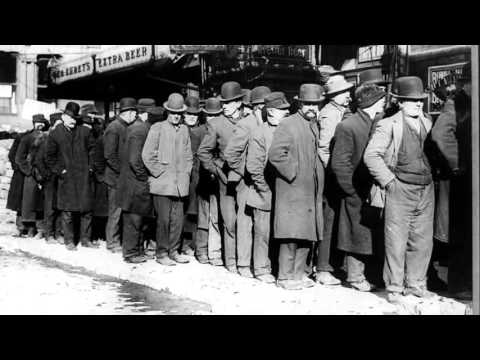 |
| Panic of 1893 YouTube Video |
Needless to say, with businesses folding and most of America barely able to put food on their tables or eke out the necessities of life; life became hard.
Between the Panic of 1893 and a series of unfortunate events, the A.H. Andrews Company struggled to stay afloat...
- June 17, 1891, The Iron Workers Strike; 150 metalworkers in the factories of A.H. Andrews & Co. struck for more pay and forced the company to shut down for a time;
- Sept. 21, 1891, A fire at one of the Andrews Co. lumber yards caused $200 in damage (translates to around $5,700 today);
- Dec., 1892, A former employee is charged with defrauding the A.H. Andrews Co. of $100,000;
- Feb. 20, 1893 (the Panic of 1893) was the first realization of serious economic depression in the US where the booming over-building and over-extending came to a screeching halt; supply quickly outgrew demand, and furniture sales became nonexistent.
- April 7, 1893 School Furniture Company/Conglomeration Anti-Trust Rumor
- 1894 More defrauding pertaining to A.H. Andrews Co.
Mr. Andrews' business succumbed to financial distress a couple of times, and the sheriff took possession of their store and factory on December 5, 1895 (the courts were very apologetic to dear Mr. Andrews).
"In various forms the company has been in existence thirty years and its business has increased in volume every year until two years ago. Since that time, about the time of the general depression, the business decreased at an alarming rate. For several months the company has been embarrassed...".
Dec. 6, 1895 The Herald, Los Angeles, CA
"In various forms the company has been in existence thirty years and its business has increased in volume every year until two years ago. Since that time, about the time of the general depression, the business decreased at an alarming rate. For several months the company has been embarrassed...".
Dec. 6, 1895 The Herald, Los Angeles, CA
You Can't Keep a Good Man Down
It is said that through it all, Mr. Andrews retained a cheerful, optimistic outlook on life. On March 26, 1896, just 3 1/2 months following the closure of the A.H. Andrews Co., it is reported that Alfred H. Andrews, James Heaney, and William Merle, Sr. (Messers Heaney & Merle were former competitors of Mr. Andrews) incorporated the A.H. Andrews Company with Messers Heaney & Merle as controlling stock partners. Mr. Andrews remained the president of his company until the time of his death in 1914, at which time William Merle took over with Mr. Heaney as treasurer; although Mr. Andrews connection with the firm was nominal for some years and he was not responsible for its management. The Merle & Heaney Manufacturing Co. were kept separate from the A.H. Andrews Co.. Actually, history seems to get a little murky at this point with conflicting sources on the merger. More than one source stated they merged two years earlier in 1894, another says 1893, and yet another says 1889; it's hard to say, but an earlier merger would have placed it prior to the foreclosure, hmm.
After the merger, I find little about the A.H. Andrews Company, but it seemed to go into a steady decline. The land and buildings of A.H. Andrews were sold in July, 1896, however the A. H. Andrews Co. remained in business in rented space. I see Andrews ads through at least 1905, and a lawsuit in 1918 (the A.H. Andrews lawyer seemed very busy). A very pared down Andrews Co. still existed at least through April 18, 1937 as the Chicago Tribune reported of the Company renting in the "Champlain Building" (Chicago) at that time; by this time W.F. Merle, Jr. was President following his dad's death January 28, 1921. It is difficult to discern exactly when it happened, but the Merle & Heaney Company appears to have gone out of business in 1923 and I find no record of when the A.H. Andrews Company went out of business (sigh).
A.H. Andrews, the Man
For all of A.H. Andrews' accomplishments, relatively little is known of his personal life. Unlike many of the successful men & aristocratic families of the Gilded Age, Mr. Andrews remained a very kind, just, hardworking, humble, and devout man. He was very well liked by employees and the public at large! I believe the following excerpt from, again, the "Common-Sense" bankers periodical of 1904 describes A.H. Andrews best...
(from an interview by Anne Shannon Monroe)
One has only to sit talking with Mr. Andrews a while to realize the genial kind hearted man he is. Wholly unspoiled by business, broad-minded, charitable, kindly disposed toward all men, there is no one of the old galaxy of Chicago's stalwarts better known, better loved, more esteemed than A. H. Andrews.
His sympathies are keen, and his interest fresh as that of a boy. He avoids publicity, never having given an interview nor his picture for the purpose of write-up; but when I said to him: "Now, Mr. Andrews, there are thousands of young men and women who are ambitious to amount to something in the world, and it would really be a kindness on your part to give them some light, on their way, from your own early struggles" -- his eyes kindled and his fine face took on a look of sympathy that readily explained why he is loved by every young man who has come within his influence.
Bending forward and speaking most earnestly, he said: "It is all hard work, and willingness to adopt new ideas. In my youth, it was no unusual thing with me to work 15 hours a day, and often and often I have left my brother working at the office at midnight, to find him still there when I got down in the morning; and he would work all day, without an hour's sleep. When we had an idea to work out, or a scheme to promote, we never thought of sleep or food. Hard work is the secret of success."
"But many men work hard all their lives," I suggested, "and never reach a place when they can be called a success."
"This is because they do not choose simply one line and stick to it. A man must find out, early, what he is best fitted for, and do nothing else. he must reach out for every new idea, work intelligently, not alone doggedly, and be ready for innovations. This is an age calling for special qualification -- for special knowledge."
When other young men were at ball games and other attractive resorts, A.H. Andrews was bending over an office desk. It was said in those days, that the light never went out in the Andrews' office.------
When a young man decides that there is "no chance nowadays, anyway," and goes to the theater or to the bowling alleys to pass away the time, let him recall the experience of A.H. Andrews and his three years of working 15 hours a day in order to get a start. Let him remember that while other men slept, A.H. Andrews was planning a simple little device for children. While others killed time, A.H. Andrews was getting all he could out of every moment given him.
Of Genealogy & History
Alfred Hinsdale Andrews
Dec. 25, 1836 - June 10, 1914 (age 77)
A.H. Andrews was the third son of Deacon Alfred and Mary L. (Shipman) Andrews, both of sterling integrity and high esteem. His father was at one time an extensive manufacturer in wood, iron, and leather. In later life, as a diversion, he turned his attention to literary pursuits, and prepared & published three large works, two being genealogical. His grandfather on his father's side was an officer in the War of 1812. His grandfather on his mother's side was a brass manufacturer.
A.H. attended common, high and normal schools and worked on his father's homestead farm. At age sixteen, he worked at a mechanical business and attended one term at the Connecticut Literary Institution in Suffield, Conn.. Evidently literary study was not his cup of tea, but rather he devoted much attention to the study of mechanics.
A.H. was married February 6, 1872 in Milwaukee, WI to Ella Cornelia/Carnelia? Matson (5/13/1851 - 11/8/1923), daughter of Deacon Newell Matson & Flora Melissa Case, his wife, of Simsbury, Conn & Milwaukee, WI. His wife, Ella, was prominent in literary and society work; member of the Amateur Musical Club and Woman's Club of Chicago, and member of several art and literary clubs.
Mr. & Mrs. Andrews lived in Chicago until 1891 and then resided at their country estate at Ellynside, Lombard, Du Page County, IL (west of Chicago). It was said their house was the oldest and best known in the US.
Mr. & Mrs. Andrews had one son and one daughter. Their son, Herbert Cornelius Andrews (3/19/1883 - 5/31/1905) worked at the LA branch of the A.H. Andrews Co. for one year, but refused a fine position there in order to follow his great love in genealogy, like his grandfather, completing extensive works in that area. Herbert was always sickly and died at the age of 22 at his parent's home. Their daughter, Bertha Matson Andrews (6/8/1874 - 6/7/1947), graduated from the Rockford Seminary and the Chicago Kindergarten College and was director of Kindergarten and Training Teacher of the Colorado State Normal School 1901-02 and wrote ABC books. She married Dr. Arthur Tenney Holbrook on July 29, 1903 in Lombard, IL and had three sons, Arthur A., Herbert, and Matson. Hmm, I'm wondering if there was a connection between A.T. Holbrook and the Holbrook School Apparatus Co. where A.H. Andrews got his start; I'm not finding one, but I'm guessing there was.
A. H. Andrews was a member of the Society of Colonial Wars and a Republican, but never held a political office as his inclinations had been only towards business. "He was in full accord with the bold anti-slavery stand maintained by his church before and during the [Civil] War."
As a Congregationalist, he was member of the Congregational Club of Chicago and several church organizations; active member of the Union Park Congregational Church and regular attender of the Plymouth Congregational Church, and later after their move to their country home, a trustee at the First Congregational Church of Lombard, all within the Chicago area.
Mr. Andrews was well-spoken of by his relatives as very loyal and kind to his kindred, and ready to aid those not so successful in life as himself.
 |
| A.H. Andrews' simple gravestone at Babcock's Grove Cemetery, Lombard, IL |
----------
Oh my, well, that wraps it up for my study on A.H. Andrews. If you made it through the whole post, you get two gold stars. :) I hope you found it interesting &/or perhaps spurred you on to doing your own research on something you might value, no matter it's actual worth. Since starting this study, I became so impressed with the man and his company, that I'm now wanting to purchase an original A.H. Andrews' chalkboard eraser for a little chalkboard that we place above the table on our front porch... and maybe a globe (right Kyle?) :).
Have a Blessed Day!
jane


